![[<- Back]](images/b_back.gif)
![[Next ->]](images/b_next.gif)
Hyperbike home page / Technology

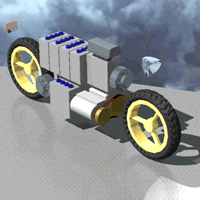
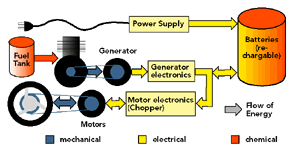
The hybrid propulsion concept combines the advantages of electric driving
(efficiency, smoothness, elegance) with the vast operating range of
combustion engines. For short distances, the electric motors get the
propulsion energy entirely from the batteries (thus having zero emission
in short range traffic). For longer distances, the hybrid module
(combustion engine coupled with a generator) is producing the
average of the required driving power, while the batteries support peak
power requirements. As the combustion engine runs in its optimal
rotational speed range, the energy consumption is significantly lower
than with conventional propulsion.

Please use our
on-line questionnaire to tell us what
you think about these specifications (and other project related issues).
Thank you!
Electronics plays a integrative role in the hybrid electric motorcycle. Electronics links the different components to form an intelligent system.
A hybrid vehicle consists of different functional units like batteries, electrical motors, combustion engine and generator (hybrid module), stationary battery charging power converter, lighting and display. To archieve an easy and comfortable way of driving, the vehice must behave as an whole ergonomically. This requires coordination between the separate functional units.
For example, the hybrid module must be switched on and off depending on the charge level of the batteries. The cockpit should display data such as reach, energy consumption. These values often depend on measurement data from multiple units.
A common control method for all subsystems is therefore required. However, to avoid complete dependency on a complex, central controller module, the hybrid electric motorcycle uses a modular control system. Each functional unit has its own, intelligent control module, that is able to operate mostly on its own. However, all control modules are linked with a bus. The bus allows the modules to exchange information and cooperate optimally. In case of a problem, each module is able to keep working with a replacement strategy on its own (and thus keep the vehicle running, even if a subsystem may fail).
As bus system the CAN (Controller Area Network) is used, a bus
developed by Bosch for the automotive industry and widely used in
various control applications now. The CAN bus is optimized for transmitting
control data fast and reliably between microprocessor modules.
Please use our
on-line questionnaire,
to give us feedback about the hybrid electric motorcycle project,
or contact us directly! Thank you!
Hyperbike home page / Technology
Last change by LuZ,
23-Mar-12